Growing Pains That Aren’t Just “Growing Pains”: A Parent’s Guide to Sever’s Disease and Osgood-Schlatter’s
If your child has been limping off the soccer pitch, complaining of sore heels after footy training, or rubbing their knees after a run, you’re not alone — and it’s probably not something to ignore. Two of the most common causes of knee and heel pain in active kids are Sever’s disease and Osgood-Schlatter’s disease, and together they affect a huge number of children aged 8 to 15.
The good news? Both are manageable, and 90% of kids come out the other side just fine.
What Are They?
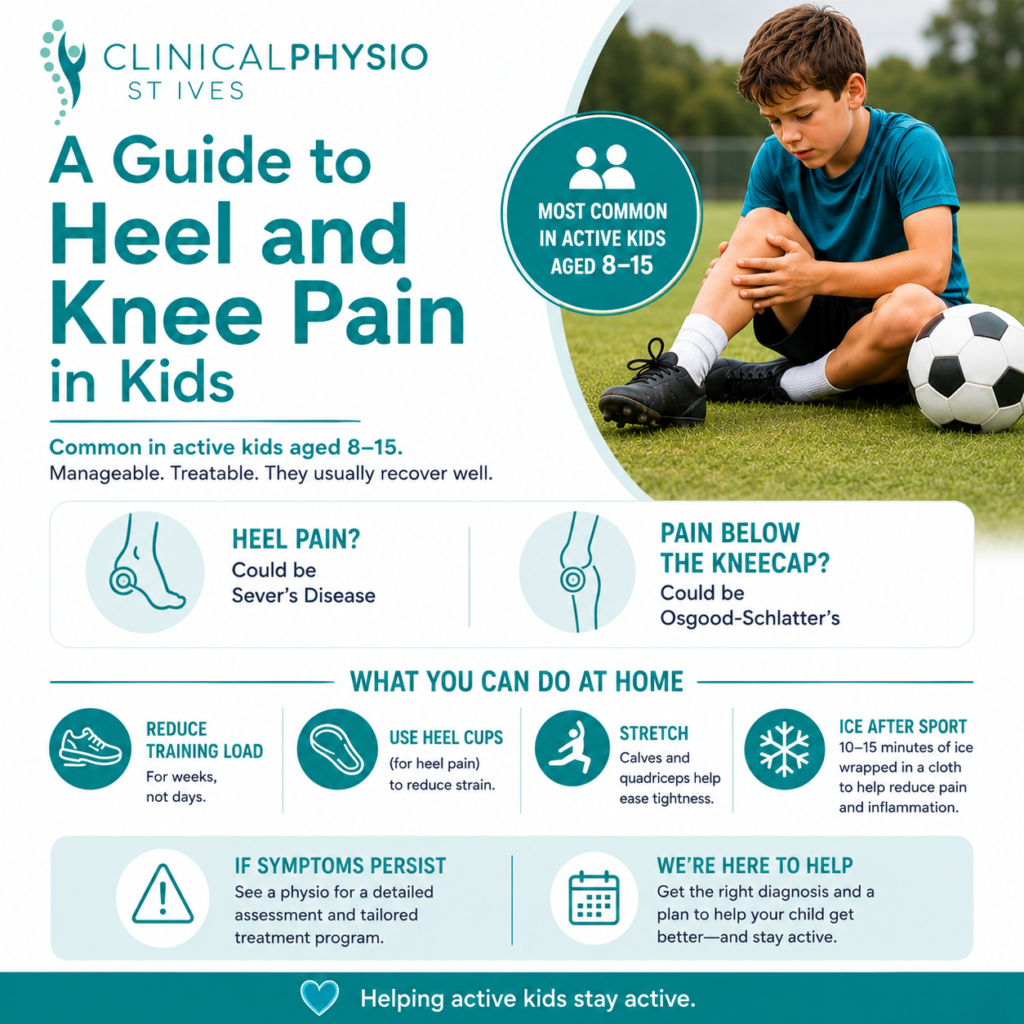
Sever’s disease (calcaneal apophysitis) is the leading cause of heel pain in children, most commonly affecting kids aged 8–12. Osgood-Schlatter’s disease causes pain and sometimes a bony lump just below the kneecap, typically appearing in children aged 10–15. Despite the word “disease,” neither condition is sinister. Both involve irritation at a growth plate — a soft area of developing cartilage where tendons attach to bone. During a growth spurt, bones can lengthen faster than muscles and tendons can keep up, creating tightness and increased pull at these sensitive sites. Add sport on top, and the result is pain.
Research confirms that participation in organised sport is the most consistent risk factor, with higher training loads and early sport specialisation significantly increasing the likelihood of developing these conditions (Launay, 2015).
How to Manage It at Home
The cornerstone of treatment is load management — reducing the stress on the growth plate while keeping your child reasonably active. Here’s what the evidence supports:
Heel cups for Sever’s: Gel heel cups (available from Clinical Physio or your local pharmacy) cushion the heel and reduce the pull of the Achilles tendon on the growth plate. A systematic review by Wiegerinck et al. (2014) found heel padding and activity modification produced consistent symptom relief in children with calcaneal apophysitis.
Stretching: Gentle calf stretches (gastrocnemius and soleus) and quadriceps stretches address the muscular tightness that drives symptoms in both conditions. Evidence from prospective cohort studies supports stretching as a meaningful component of conservative management (James, Williams & Haines, 2013)
Ice after activity: Ten to fifteen minutes of ice wrapped in a cloth after sport helps manage localised inflammation.
Modify Load — Don’t Just Push Through
This is the most important message. Pain during or after sport is a signal, not a challenge to overcome. If your child is limping, reducing their training load for a period of weeks — not just days — is appropriate and evidence-based. A long-term cohort study by Howell (2012) found that children who continued to train at high loads despite symptoms had significantly prolonged recovery times compared to those who modified activity early.
Watch for Growth Spurts
These conditions tend to flare during rapid growth. If your child has recently shot up in height, be especially watchful. Monitoring growth and reducing training load proactively during these windows can prevent the problem from taking hold in the first place.
Early Sport Specialisation: A Word of Caution
Children who specialise in a single sport before age 12 carry a significantly higher injury burden than those who play multiple sports (Jayanthi et al., Sports Health, 2013 — a large prospective cohort study). A useful rule of thumb: a child’s total weekly training hours in organised sport should not exceed their age. An 8-year-old doing more than 8 hours of structured sport per week is at meaningfully elevated risk. Variety, rest, and free play aren’t optional extras — they’re injury prevention.
When to See a Physio
If symptoms persist beyond two to three weeks despite load modification, or if your child is avoiding activity altogether, it’s worth getting them assessed. We can confirm the diagnosis, rule out other causes, and put together a specific plan.
Pop in to see us at Clinical Physio, or feel free to reach out through our website.
References
- James AM, Williams CM, Haines TP. Effectiveness of interventions in reducing pain and maintaining physical activity in children and adolescents with calcaneal apophysitis (Sever’s disease): a systematic review. Journal of Foot and Ankle Research. 2013;6(1):16. doi: 10.1186/1757-1146-6-16
- Howell DW. (2012). Musculoskeletal profile and incidence of musculoskeletal injuries in lightweight women rowers. American Journal of Sports Medicine.
- Jayanthi NA et al. (2013). Sports specialization in young athletes: evidence-based recommendations. Sports Health, 5(3), 251–257.
- Launay F. (2015). Sports-related overuse injuries in children. Journal of Children’s Orthopaedics, 9(4), 245–254.
- Wiegerinck JI et al. (2014). Treatment of calcaneal apophysitis: wait and see versus orthotic device versus physical therapy. Journal of Foot and Ankle Surgery, 53(5), 657–664.