
Top 10 Running Myths
Running is one of the most accessible and effective forms of exercise. It improves cardiovascular fitness, supports mental health, builds resilience, and can be done almost anywhere.
But running also comes with a long list of myths.
You may have heard that heel striking is bad, everyone should run at 180 steps per minute, overpronation causes injuries, or that running will eventually ruin your knees. These ideas are repeated so often that many runners start to believe there is one “perfect” way to run.
The reality is more nuanced.
Most running injuries are not caused by one isolated factor such as foot posture, shoe type, or running style. They usually occur when training load exceeds the body’s current capacity to tolerate that load.
In simple terms: Running Injuries Are Usually a Load vs Capacity Problem
Running injuries often occur when:
Training load > tissue capacity
That may happen after a sudden increase in mileage, adding too much speed work, insufficient recovery, poor sleep, inadequate strength, or returning too quickly after time off.
Common running-related injuries include:
- Patellofemoral pain
- Medial tibial stress syndrome, commonly called shin splints
- Achilles tendinopathy
- Plantar heel pain
- Bone stress injuries
- Proximal hamstring tendinopathy
- Iliotibial band pain
The key clinical question is not usually, “Is this runner built wrong?”
A better question is:
What load is this runner currently exposed to, and do they have the capacity to tolerate it?
Myth 1: Heel Striking Causes Injury
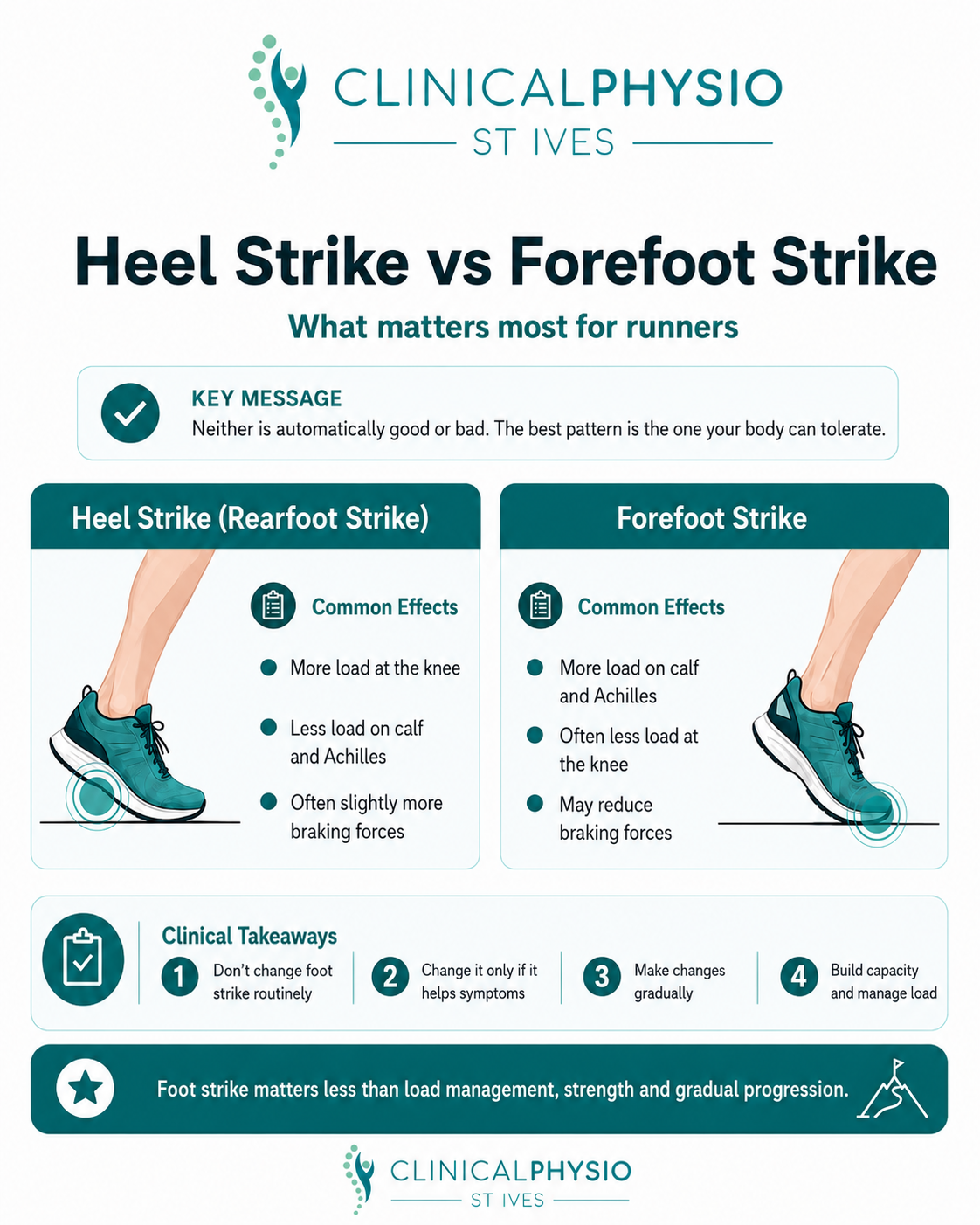
Heel striking is often blamed for running injuries, but the evidence does not support the idea that heel striking is universally harmful.
Many recreational and even elite runners use a rearfoot strike pattern. The problem is not simply where the foot lands. The issue is whether the runner can tolerate the loads associated with their running style.
Changing from a heel strike to a forefoot strike does not remove load from the body. It simply shifts load elsewhere.
A rearfoot strike may increase loading around the knee.
A forefoot strike may increase loading through the calf, Achilles tendon and metatarsals.
That means changing foot strike may help some runners, but it can aggravate others.
For example, a runner with patellofemoral pain may sometimes benefit from a slightly more forward foot strike or increased cadence if it reduces knee load. But a runner with Achilles tendinopathy may worsen if they suddenly move to a forefoot strike.
Clinical Takeaway
Do not change foot strike just because social media says heel striking is bad.
Foot strike changes should only be used when there is a clear injury-specific reason, the change is introduced gradually, and the runner can tolerate the new loading pattern.
Myth 2: Everyone Should Run at 180 Cadence
The idea that all runners should run at 180 steps per minute came from observations of elite runners. It was never meant to be a universal rule.
Cadence is highly individual. Recreational runners often run at a lower cadence, and that is not automatically a problem.
However, cadence can be a useful tool.
A small increase in cadence, usually around 5–10%, can reduce overstriding, braking forces, vertical loading and knee load. This may be particularly useful for runners with patellofemoral pain or tibial stress injuries.
But more is not always better.
If cadence is increased too much, it may feel unnatural, reduce running economy, and increase fatigue.
Clinical Takeaway
Cadence is not a magic number. Rather than aiming for 180, most runners are better off making small, targeted changes when there is a clear reason to do so.
Myth 3: Overpronation Is the Main Cause of Running Injuries
For years, runners were told that overpronation was one of the main causes of injury. This led many people to believe that a “flat foot” or pronated foot position needed to be corrected.
The research is much less convincing.
Static foot posture is a poor predictor of running injury. Many runners with pronated feet are completely pain-free, while many runners with “normal” arches still get injured.
What matters more is how the runner tolerates load dynamically.
More important predictors of injury often include:
- Previous injury
- Sudden increases in training load
- Inadequate recovery
- Low energy availability
- Poor sleep
- Training monotony
- Strength deficits
- Poor load management
Foot posture may be relevant in some cases, but it is rarely the whole story.
Clinical Takeaway
Pronation is not automatically a problem. The goal is not to make every foot look the same. The goal is to help the runner tolerate the demands of running.
Myth 4: Bad Running Form Causes Injury
There is no single ideal running form.
Running gait is highly individual. It is influenced by anatomy, strength, mobility, speed, training history, footwear, fatigue, and the type of running being performed.
Trying to “perfect” a runner’s technique can sometimes create more problems than it solves. Overthinking running form may increase cognitive load, reduce efficiency, and even provoke new symptoms.
That does not mean gait retraining is useless. It can be very helpful when used for the right reasons.
Gait retraining may be useful when:
- A specific tissue needs to be unloaded
- Symptoms are clearly load-sensitive
- A runner repeatedly demonstrates a modifiable pattern linked to their pain
- Cadence, stride length or trunk position can reduce symptoms
- Running economy is important for performance
Examples include patellofemoral pain, tibial stress injuries and some cases of hip pain.
Clinical Takeaway
Not every asymmetry needs correction. Gait retraining should be targeted, not cosmetic.
Myth 5: Minimalist Shoes Prevent Injuries
Minimalist shoes became popular because they were thought to encourage a more “natural” running style. But less cushioning does not automatically mean fewer injuries.
Minimalist shoes tend to increase calf, Achilles and foot intrinsic muscle demand. For some runners, this may be useful if introduced gradually. For others, especially those not adapted to that load, it may increase injury risk.
The evidence does not clearly show that minimalist shoes are superior for injury prevention compared with other shoe types.
Clinical Takeaway
Minimalist shoes are not bad, but they are not a universal solution. Transitioning too quickly can overload the calf, Achilles tendon, plantar fascia or metatarsals.
Myth 6: Carbon-Plated Shoes Cause Injury
Carbon-plated shoes can improve running economy and performance for many runners. They are not inherently dangerous.
The issue is usually not the shoe itself, but how it is introduced and used.
Potential problems include:
- Rapid transition into a very different shoe
- Altered calf and foot loading
- Increased training intensity because the runner feels faster
- Using race shoes too often in training
- Not being conditioned for the demands of the shoe
Carbon-plated shoes may change how force is distributed through the lower limb. That does not mean they should be avoided, but it does mean runners should be sensible.
Clinical Takeaway
Carbon-plated shoes are a performance tool, not an everyday shortcut. Introduce them gradually and avoid using them for every session.
Myth 7: More Cushioning Is Always Safer
It seems logical that softer shoes would reduce injury risk, but this is not always the case.
More cushioning can change a runner’s loading strategy. Some runners may actually hit the ground harder in highly cushioned shoes, possibly because the shoe reduces their perception of impact.
More cushioning may be helpful for comfort and may reduce load in some areas, but it does not guarantee lower injury risk.
Clinical Takeaway
The best shoe is not always the softest shoe. Comfort, training history, injury history, running goals and individual response all matter.
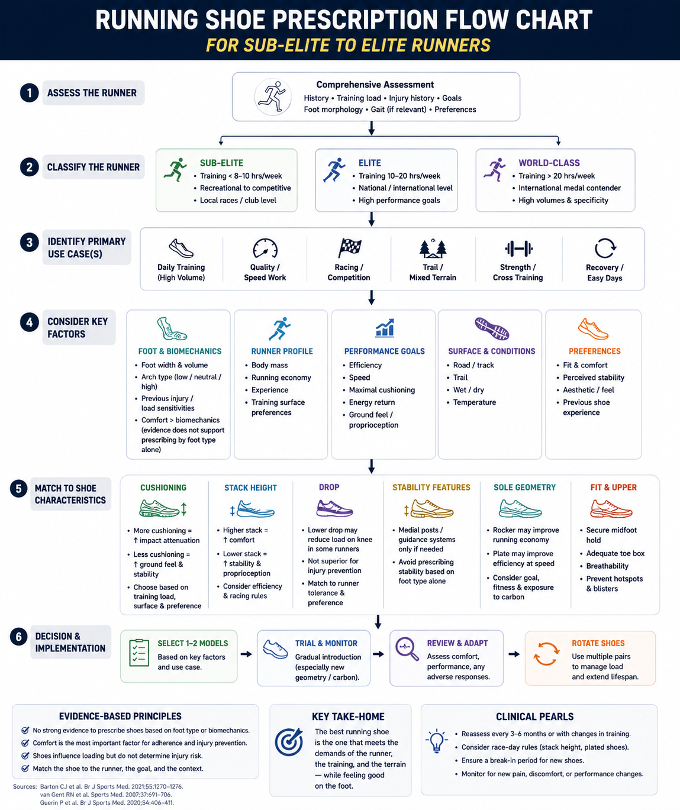
Not sure which shoe suits you best? This flow chart may help!
Myth 8: Running Ruins Your Knees
This is one of the most persistent running myths.
Recreational running is not associated with higher rates of knee osteoarthritis. In fact, recreational runners may have a lower risk of knee osteoarthritis compared with sedentary people.
The key distinction is between sensible recreational running and extreme cumulative loading without adequate recovery.
Running can be very healthy for joints when training is progressed appropriately, strength is maintained, and symptoms are respected.
Clinical Takeaway
Running does not automatically ruin your knees. For many people, it may actually support joint health.
Myth 9: You Need to Carb Load Before Every Race
Carbohydrate loading can improve performance in longer endurance events, but it is not necessary for every race or every runner.
Carb loading is most useful when exercise duration exceeds around 90 minutes, particularly in events such as marathons, long-distance triathlons and prolonged cycling events.
For shorter races, regular carbohydrate intake and sensible pre-race nutrition are usually enough.
Carbohydrate loading may help by:
- Increasing muscle glycogen stores
- Delaying fatigue
- Improving endurance performance
But for shorter events, aggressive carb loading may simply cause unnecessary bloating, heaviness or gut discomfort.
Clinical Takeaway
Carb loading should match the event. A 5 km or 10 km race does not require the same strategy as a marathon.
Myth 10: All Endurance Athletes Need Gels
Gels are useful in some situations, but they are not mandatory.
Carbohydrate intake during exercise is most beneficial when sessions or races last longer than about 60–90 minutes. Gels can help maintain blood glucose, delay fatigue and support performance during prolonged endurance exercise.
They may be useful for:
- Marathons
- Half marathons
- Long cycling sessions
- Triathlon
- High-volume endurance training
- Sessions longer than 90 minutes
- Multiple-session training days
But they are often unnecessary for:
- Sessions under 60 minutes
- Low-intensity aerobic runs
- Sprint or power events
- Athletes who tolerate whole foods better
- Lower glycogen demand sessions
Gels can also cause issues such as bloating, diarrhoea, gut discomfort, flavour fatigue and overconsumption of carbohydrates.
Whole-food alternatives may include bananas, rice cakes, sports drinks, dried fruit, bars, honey sandwiches or potatoes.
Clinical Takeaway
The best fuel is the one the athlete tolerates and can consistently use. Nutrition should be practised in training, not trialled for the first time on race day.
Myth 11: More Training Is Always Better
More is rarely better. Better is better.
Performance is not built by simply accumulating as much training as possible. It is built through the right balance of stress, recovery and adaptation.
High-level endurance performance is usually based on:
- Specificity
- Quality
- Recovery
- Intelligent programming
- Progressive overload
- Adequate adaptation
Many runners fall into the trap of doing too much “moderately hard” running. These sessions are hard enough to create fatigue, but not always hard enough to drive the desired adaptation.
This is sometimes called the “middle zone” problem.
The runner is going too fast to recover properly, but too slow to develop true speed or high-end aerobic power.
Over time, this can lead to:
- Stagnation
- Excessive fatigue
- Poor adaptation
- Illness
- Injury accumulation
- Reduced performance
Successful endurance programs often include a large amount of easy running, combined with smaller doses of high-quality intensity.
Clinical Takeaway
Adaptation happens during recovery, not during the accumulation of fatigue. The goal is not to do the most training possible. The goal is to do the least amount of training required to create the desired adaptation.
Two Common Running Programming Errors
Error 1: No Clear Session Goal
Every run should have a purpose.
Is the session designed to build aerobic capacity? Improve speed? Develop threshold? Promote recovery? Prepare for race pace? Build durability?
When there is no clear goal, runners often end up doing everything at the same moderate intensity. This can reduce training quality and increase fatigue.
Error 2: Prescribing Purely Off Pace
Pace is useful, but it should not be the only guide.
Heat, hills, fatigue, sleep, stress, terrain and wind can all change how hard a pace feels. Prescribing only by pace can lead runners to work too hard on days when the body is not ready.
Better options may include combining pace with:
- Rate of perceived exertion
- Heart rate
- Session goal
- Terrain
- Recovery status
- Recent training load
- Symptoms
The Big Picture: Stop Chasing Perfect Running Form
Running injuries are rarely caused by one single flaw.
They are usually the result of multiple factors interacting over time. Foot strike, cadence, shoes, strength, sleep, recovery, nutrition, training load and previous injury history can all play a role.
The goal is not to create the perfect-looking runner.
The goal is to create a runner who can tolerate the demands of their training, recover well, and progress gradually.
Key Takeaways
- Heel striking is not automatically bad.
- A cadence of 180 is not required for everyone.
- Pronation is not necessarily a problem.
- There is no single perfect running style.
- Minimalist shoes, maximalist shoes and carbon-plated shoes all have pros and cons.
- Running does not ruin your knees.
- Carb loading and gels are useful in specific contexts, not for every runner.
- More training is not always better.
- The most important principle is matching training load to the runner’s current capacity.
- When runners understand this, they can stop chasing myths and start making smarter decisions about training, injury prevention and performance.